
Free shipping on orders over €45
Our shop is open • 87 Rue Lemercier, Paris 17th
Free shipping on orders over €45
Our shop is open • 87 Rue Lemercier, Paris 17th
Free shipping on orders over €45
Our shop is open • 87 Rue Lemercier, Paris 17th
Free shipping on orders over €45
Our shop is open • 87 Rue Lemercier, Paris 17th
When we talk about tea, it is essential to talk about China and Chinese teas. Indeed, it is the cradle of tea, and this plant quickly took on an important place, becoming an essential commodity alongside wood and salt. Tea rhymes with spirituality, ritual, art and, of course, tasting.
The discovery of tea in China is associated with several legends, the best known of which is the legend of Emperor Shennong, the father of Chinese pharmacopoeia. This legend is dated to 2737 BC. It tells that Shennong had a transparent body and could thus observe the effect of each plant on his organs. One day, after testing more than 70 plants, his body became very dark and he felt very tired. He dozed off in the shade of a tree. The breeze shook one of the branches of the tree under which Shennong had fallen asleep, and a leaf fell into his cup of hot water. He drank the brew with interest and curiosity. He found it very thirst-quenching and gradually felt less tired. His body returned to its initial state. The magic of the tea leaf had worked! This legend is interesting because it highlights the two great virtues of tea: the virtue of alertness, thanks to caffeine (theine), and the virtues for health.

In China, tea would be consumed until the Christian era as a medicine, in a poultice or a concentrated drink — far from today’s cup of tea — to treat migraines, rheumatism and so on.
Gradually, tea would move from a rare drink, consumed by an elite during great ceremonies, to a more popular drink, consumed more and more regularly.
Tea cultivation developed. For climatic reasons, the tea gardens are located in the southern part of China. Many provinces grow tea. Lu Yu, in his treatise on tea in 760, counted 14 of them and listed 145 crus. Today, the number of tea provinces has extended to 19.
Here are the most renowned provinces:
Yunnan, very well known for its pu erh
Zhejiang, very well known for its green teas, notably Long Jing
Fujian, very well known for its oolongs and its jasmine teas
Anhui, very well known for the teas of the Huang Shan mountains and other great crus
But also Sichuan, Hubei, Guangdong, etc.

Chinese teas are extremely rich — why?
– A richness of terroir! The country is so vast that each terroir offers a very particular typicity, giving the tea an identity.
– The richness of the varieties: many hybrids are formed, giving rise to different varieties. But China is also very active in agronomic research. Each region develops cultivars to meet very specific expectations.
Each variety brings typicities that combine with the terroir.
Here are a few well-known varieties that sometimes give the tea its name:
– Tie Guan Yin, the very famous oolong from Fujian,
– Da Hong Pao, an oolong from the Wuyi mountains, or Hou Gui
– Da Ye, a large-leaved variety traditionally used to make pu erh teas
A very great number of varieties exist, known or not by the producers.

Even though China produces and consumes green tea almost exclusively, it masters all the other colours.
You can thus find teas for mass consumption but also great crus in all categories, such as:
Yin Zhen or Bai Mu Dan for white teas
Long Jing, Bi Lo Chun, Bai Mao Hou, gunpowder… for green teas
Tie Guan Yin, Dan Cong, rock teas such as the famous Da Hong Pao for oolongs
Qimen, Dian Hong, the must-have Yunnan teas for black teas
And of course the Pu erh for dark teas
A beautiful sensory journey is in prospect to explore the typicity of each region, of each colour.
Here are a few references from our selection that can accompany you in this discovery:
The 98 – Bai Mu Dan, a white tea from the Fujian region, with floral and honeyed notes
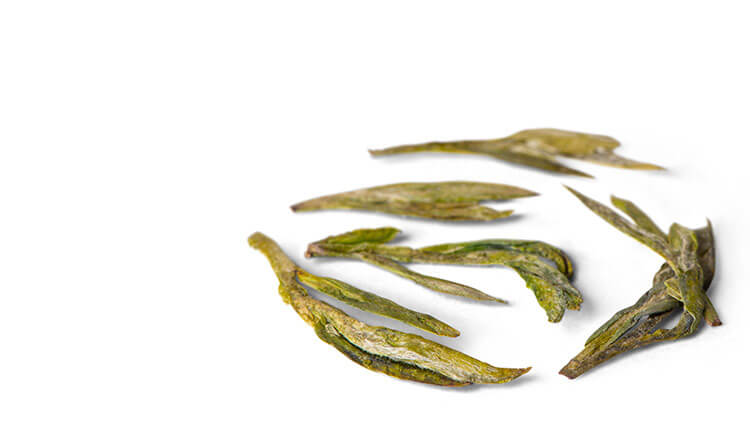
The 59 – Long Jing Premium, a first-harvest green tea from the Zhejiang region, with magnificent vegetal, mineral and fruity notes
The 189 – Anxi Tie Guan Yin, an oolong from Fujian, with very floral, buttery, milky and vegetal notes
Or the 80 – Da Hong Pao, an oolong also from Fujian but from the Wuyi mountains, with woody, very fruity, toasted notes of great complexity
The 06 – Dian Hong, a black tea from Yunnan, with captivating notes of malt, honey, chocolate and also rose
And very soon, a selection of Pu erh from the Yunnan region.
Enjoy!