
Free shipping on orders over €45
Opening soon • 87 Rue Lemercier, Paris 17th
Free shipping on orders over €45
Opening soon • 87 Rue Lemercier, Paris 17th
Free shipping on orders over €45
Opening soon • 87 Rue Lemercier, Paris 17th
Free shipping on orders over €45
Opening soon • 87 Rue Lemercier, Paris 17th
The birth of a premium nunshen tea is first of all an encounter — that of Carine Baudry, nunshen’s nose and expert-taster, and tea producers at the heart of the most beautiful gardens. The sourcing of tea is the first stage of production; it is the meeting of a terroir and the expertise of Maison nunshen. The choice of a tea reflects nunshen’s passion for respecting cultures, for harmonious collaboration with producers, for choosing exclusive plantations and a determination to move towards sustainable production.
Ceylon, Darjeeling, Yunnan, Sichuan — so many territories whose names have echoed through the history of tea for millennia. Yet the gardens of the great tea crus reach far beyond these few regions. Sri Lanka, Taiwan, Vietnam, Japan, China, Malawi, South Africa… the provenance and terroirs of nunshen teas are many. While China and India are the world’s two leading tea-producing countries, many terroirs exist and give all their character to the various teas Maison nunshen offers.

To source a tea is to set out to meet producers across territories rich in their culture, their climate, their history and their traditions. To see, smell, touch, taste — sourcing awakens all the senses of the expert-taster.
It is an adventure, a sharing of knowledge and know-how with each journey, to understand the story of a tea and translate all the subtlety of its flavours. The path is long, and many tasting stages follow one another before a tea is offered. Some will be sourced to then join the nunshen references; others will be chosen for their singularity, combined with other varieties to craft exceptional creations.
At the origin of tea there is a shrub, the Camellia sinensis. It is its small matte leaves and its buds that are picked to make tea. Tea plants are traditionally grown in terraced plantations called “tea gardens”.
Harvesting takes place several times a year. The lightest leaves are those that contain the most tannins and are therefore the most subtle and sought after. The buds are also of great value.
Covered with a fine white down called “pekoe” in Chinese, the bud contains the still-young leaf rolled upon itself. It is from this bud that the harvest takes on all its importance: the youngest leaves, closest to the bud, are the most refined and will give the rarest tea.
The leaves can then be worked in different forms: whole leaves giving rare teas, broken leaves giving fairly full-bodied teas, or ground leaves.

Sourcing leads to many encounters. A true moment of sharing, sourcing is above all a human adventure, where all the senses are awakened to reveal every characteristic of a tea.
nunshen’s ambition is to work hand in hand with tea producers. It is an exchange of know-how, a sharing of knowledge of the world of tea, a common passion expressed through the quest for premium teas with exceptional flavours and subtle, refined nuances. We thus wish to build relationships of trust with producers, in order to collaborate sustainably and hand in hand in the quest for elegant, distinguished teas.
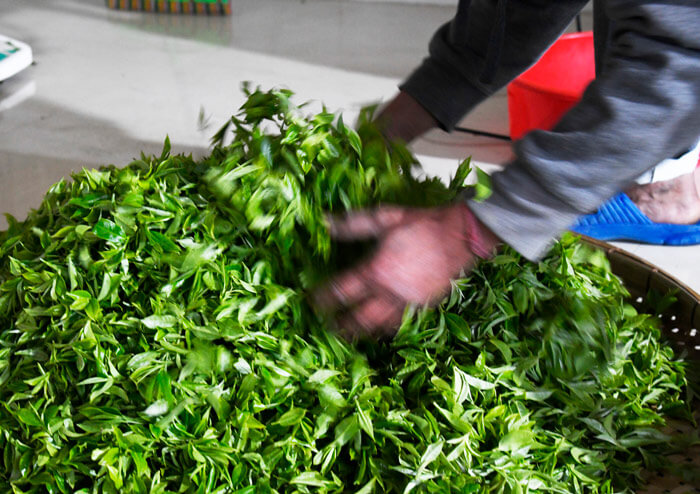
Guaranteeing the quality of nunshen teas also involves an understanding of the production stages, being particularly attentive to the impact on the environment, the quality of the farms and respect for local culture. It is also respect for people that guides the work of Carine Baudry, Sourcing Director, in a holistic approach to obtaining exceptional, responsible teas.

Maison nunshen attaches great importance to the responsible, sustainable dimension of its sourcing. The selection of crops and partner producers is carried out meticulously, taking into account cultivation methods, respect for the biodiversity of the plantation gardens, the quality of the tea, the producers’ history and their working methods. The sourcing approach is thus based on a deep respect for the producer (fair pay, trust, lasting collaboration), for their work, for the terroir and for the tradition of local tea growing. Indeed, the selected gardens are mostly human-scale and not systematically mechanised.
Building relationships of trust with producers allows nunshen to pass on and exchange its knowledge in order to support producers towards more respectful farming, in a less intensive production approach that is more mindful of the resources used, to preserve not only the quality of the tea but also the richness of the terroirs and of the people who work each day at the heart of the farms.
nunshen collaborates with Ecocert-certified plantations, a responsible-farming label that guarantees quality and respect for the environment. Organic farming practices are favoured, and a large part of the range is undergoing Ecocert certification.
Our teams are also committed to preserving forests, working hand in hand with the Alliance for the Preservation of Forests collective, which promotes the protection of natural resources, traceability and the sustainability of raw materials.
For several years nunshen has been committed to the One Percent For The Planet organisation and each year donates 1% of its turnover to a social or environmental-interest organisation, such as Charity Water.
Other initiatives allow us to position ourselves as a player mindful of the sustainability and responsibility of our production, for example by making commitments such as concentrating supplies with a single producer or distributor in order to reduce the impact on the environment.
Setting off on an adventure in search of the perfect tea is a unique experience, opening the doors to fabulous encounters at the heart of territories and cultures of many riches.
Sourcing is a crucial stage, both in the sensory experience and in the emotion of incredible encounters that allow nunshen to forge strong bonds with producers while nurturing lasting relationships, in order to develop more respectful and ever more qualitative production.
All the nunshen teams are also more than ever attentive to commitments to sustainability, respect for nature, for people and for the quality of terroirs and crops, making our Maison a responsible Fine Tea Manufacture.
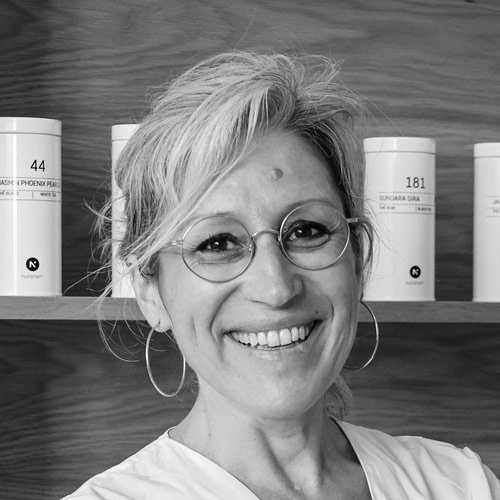
You travel a great deal for Maison nunshen.
What are your trips like and what do you go looking for?
Every journey is a different adventure. The days are punctuated by meetings, tastings and moments of freedom too, during which I take the opportunity to discover the country’s culture and taste the culinary specialities. There are also many encounters that call for a certain letting-go of our Western culture, to listen, to be human, to build relationships of trust and create connection. It is also about creating a moment of sharing knowledge around tea, and not necessarily placing oneself in the posture of a buyer.
What are the particularities of the countries and territories you discover?
There is a real richness of terroirs that moves me every time. The quality of the soil, the climate, the altitude, the traditions of working the leaf — these are all characteristics that can change a tea’s profile, influencing the choice of one production over another to best match Maison nunshen’s positioning. Sensitivity and intuition also have a strong impact on the choices I make during my encounters.
Can we speak of terroir for tea as we do for wine? Do we use the same vocabulary during a tasting?
Indeed, it is the same vocabulary that is used during a tasting session. Notes, flavours, nuances, the nose, the bouquet, the attack, tannic, astringent… of course it is above all a very sensory vocabulary that allows us to distinguish all the strengths and qualities of a tea. What’s more, Maison nunshen aims to give tea a real place by innovating through food-and-tea pairing menus; tea thus becomes a lovely non-alcoholic alternative to wine.